What Foremann is
Foremann is a B2B SaaS product, operated by Minium LLC, that provisions a dedicated business phone number for independent trade businesses (plumbers, electricians, HVAC technicians, landscapers). Each contractor operates their own number and uses it to communicate one-to-one with their own existing customers and leads. Messages are conversational and contractor-initiated, not automated bulk sends, marketing, or promotional traffic.
Two SMS programs covered by this page
Minium LLC operates two distinct SMS programs through this platform. Both are documented below.
- Parent program — Minium LLC to Foremann beta users. 1:1 messages sent from a Minium LLC-owned number to Foremann account holders (currently a small group of beta users, including the founder). Covers account confirmations, product update notifications affecting the user's account, and direct support replies. Registered as a Customer Care campaign under the Minium LLC brand. No marketing, promotional, or sales messages.
- Per-contractor program — Foremann users to their own customers. 1:1 messages sent from each contractor's dedicated business number to that contractor's own existing customers and leads. Registered as a Customer Care campaign (SOLE_PROPRIETOR use case for Sole Proprietor brands) under each contractor's own brand — a sub-customer brand registered by Minium LLC's ISV platform on the contractor's behalf (Low Volume Standard for contractors with an EIN, Sole Proprietor for SSN-only contractors).
The "How consent is captured" section below details opt-in for both programs.
Message types — parent program (Minium LLC to Foremann beta users)
Outbound SMS in the parent program is registered under the Customer Care use case and includes only:
- Account confirmations (e.g. business number is active and ready)
- Onboarding tips for new Foremann account holders
- Product update notifications affecting the user's account (e.g. a new feature is available in the app)
- Direct replies to support requests from beta users
Messages in the parent program are sent 1:1 from a single Minium LLC-owned number to specific beta users with whom Minium LLC has a pre-existing account relationship. No marketing, promotional, or sales messages. No bulk sends, no third-party offers, no affiliate marketing.
Sample messages — parent program
- "Welcome to Foremann beta! Your business number is (555) 123-4567 and is ready to use. Reply HELP for help, STOP to opt out. Msg & data rates may apply."
- "Foremann: AI draft suggestions for incoming texts is now available in your app. Open Foremann to enable it on your account. Reply STOP to opt out."
- "Foremann support: replying to your question about the AI draft feature. Let me know if that helps. Reply STOP to opt out."
Message types — per-contractor program (contractor to their customers)
Each per-contractor campaign is operated by Minium LLC's ISV platform on behalf of the contractor's business (e.g. "{business_name}"). Outbound SMS is registered under the Customer Care use case (Sole Proprietor brands use the SOLE_PROPRIETOR use case) and includes only:
- Appointment confirmations and reminders
- Quote delivery and quote follow-ups
- Job status updates ("on the way," "running late," "job complete")
- Post-job thank-yous and review requests for the contractor's own customers
- Direct replies to inbound customer messages
Message frequency varies depending on what's happening with the
customer's service request. Message and data rates may apply.
Recipients can reply HELP for help or STOP
to opt out at any time. Foremann does not send
promotional, marketing, or sales messages on this program; no
affiliate or third-party offers; no bulk or broadcast messages to
non-customers. Each message is 1:1 from a contractor to a recipient
with whom the contractor has a pre-existing service relationship.
Sample messages — per-contractor program
- "Hi {customer}, this is {business_name} confirming we'll be out tomorrow at 9am for the {trade} work. Text us if anything changes. Reply STOP to opt out."
- "Hey {customer}, following up on the {trade} quote we sent over. Any questions or want to schedule? Reply STOP to opt out."
- "Thanks for choosing {business_name} — if you have a minute we'd appreciate a quick review: {review_link}. Reply STOP to opt out, HELP for help."
Message Flow text submitted to TCR — per-contractor program
The exact verbiage submitted in the TCR campaign Message Flow field for every contractor's per-contractor campaign, reproduced here so a reviewer cross-checking from the TCR portal sees identical language:
"Customers opt in two ways: (1) inbound-first — customer texts the contractor's published business number, establishing consent for the contractor to reply; (2) in-app attestation — contractor checks an unchecked-by-default consent box when manually adding a contact, confirming the customer agreed to receive SMS. Both paths produce a verifiable consent record before any outbound SMS is sent. See https://foremann.app/consent-evidence (per-contractor program section) for visual proof."
How consent is captured — parent program (Minium LLC to Foremann account holders)
Foremann account holders provide their mobile phone number to Minium LLC via one of two paths, with explicit SMS consent captured before any outbound message is sent:
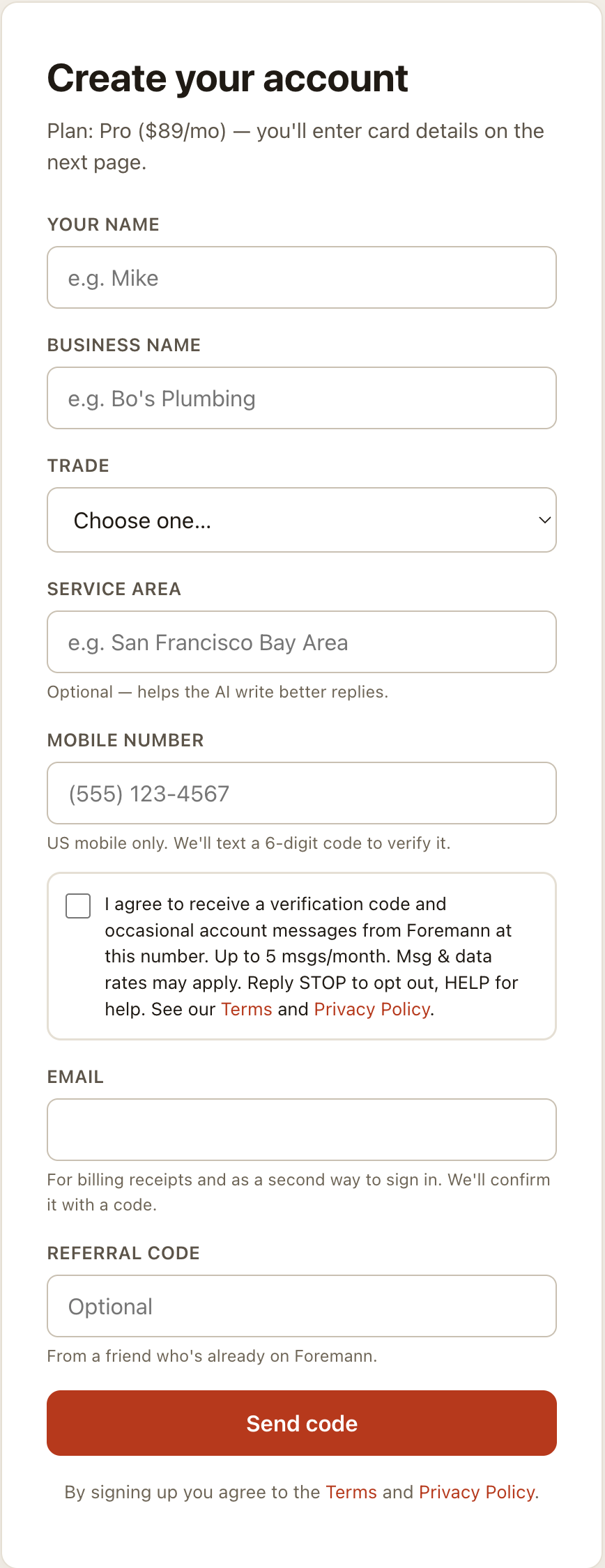
- Web sign-up form at app.foremann.app. When creating a Foremann account at app.foremann.app/signup, the user verifies by phone (SMS): the form shows a mobile-number field and an unchecked-by-default SMS consent box that reads: "I agree to receive a verification code and occasional account messages from Foremann at this number. Up to 5 msgs/month. Msg & data rates may apply. Reply STOP to opt out, HELP for help." The form will not send a code or record the number unless the consent box is also checked. The same disclosure and checkbox appear on the sign-in form at app.foremann.app/signin. A consent record (timestamp, source) is stored on the user record. See screenshot below.
- Verbal — phone or in-person. When a prospective Foremann beta user contacts Minium LLC's founder by phone or in person and asks to receive SMS updates about their Foremann account, the founder reads (or closely paraphrases) the verbal opt-in script below and obtains a verbal "yes" before any number is logged or any message is sent. If the user says no, no SMS is sent and no phone number is stored against an SMS consent record.
Verbal opt-in script — parent program
The exact script read by Minium LLC's founder to a prospective Foremann beta user during a phone call or in-person conversation, before any phone number is logged or any SMS is sent:
"Quick heads up before I add your number — Minium LLC will text you from a Foremann number with account confirmations, onboarding tips, product updates that affect your account, and replies to support questions. Message frequency varies. Message and data rates may apply. Reply STOP to opt out or HELP for help at any time. Our privacy policy at foremann.app/privacy explains we don't share your number with third parties for marketing. OK to text you at this number?"
If the user says yes, the founder logs a consent record on the
user account with: timestamp, source = "verbal",
the phone number provided, and the script version read. If the
user says no, no SMS is sent and no phone number is stored
against an SMS consent record.
Before consenting (in any path), the user is told: (a) they
will receive SMS from Minium LLC about Foremann — account
confirmations, onboarding, product updates affecting their
account, and support replies; (b) message frequency varies;
(c) message and
data rates may apply; (d) they can reply STOP at
any time to opt out or HELP for help. Consent record
is retained for the life of the account and available for audit.
The first outbound message to a new recipient identifies the
sender as Foremann and includes "Reply STOP to opt out, HELP for
help. Msg & data rates may apply." STOP state
is enforced at the platform level and cannot be bypassed.
How consent is captured — per-contractor program (contractor to their customers)
For each contractor onboarded to Foremann, Foremann supports two opt-in paths. Both produce a verifiable record before any outbound SMS is sent from that contractor's number to their own customer.
Path 1 — Inbound-first (customer texts first)
The trade business publishes their Foremann number on invoices,
business cards, signage, vehicle wraps, and their website. When a
homeowner texts that number first, the inbound message itself
establishes consent for the contractor to reply and to follow up
on the same service conversation. STOP is honored at
any point and ends all further outbound messages, regardless of
prior inbound activity.
Path 2 — In-app consent attestation (manual contact add)
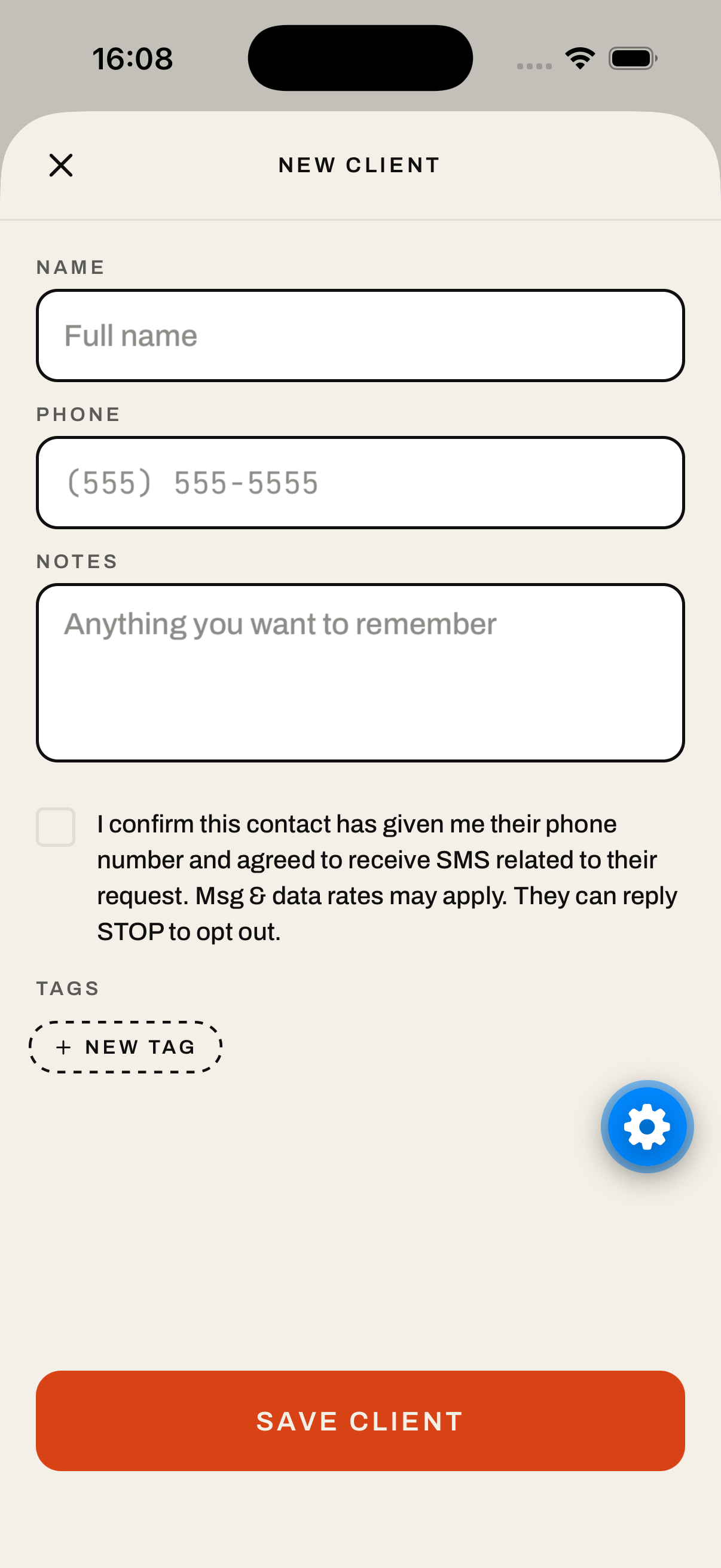
When a contractor manually adds a contact inside the Foremann app — typically after meeting the customer in person, on a service call, or by phone — the app requires the contractor to check an attestation box (unchecked by default) that reads:
"I confirm this contact has given me their phone number and agreed to receive SMS related to their request. Msg & data rates may apply. They can reply STOP to opt out."
Before checking this box, contractors are instructed to disclose to
the customer (verbally or in writing) that the contractor's business
will text them about their service request, that message and data
rates may apply, that message frequency varies, and that they can
reply STOP at any time to opt out or HELP
for help. The attestation box is the contractor's record that this
disclosure occurred.
The "Save Client" action is blocked until the box is checked. When the contact is created, Foremann records:
- The timestamp of the attestation (
sms_consent_given_at) - The user who attested (
sms_consent_given_by_user_id) - The source of the consent record (
sms_consent_source = 'manual_add_attestation')
This record is retained for the life of the contact and is available for audit on request.
Screenshot of the consent gate
The screenshot below shows the consent attestation as it appears in the Foremann mobile app when a contractor manually adds a new contact.
Opt-out handling
Recipients can reply STOP, STOPALL,
UNSUBSCRIBE, CANCEL, END,
QUIT, REVOKE, OPTOUT, or
OPT-OUT at any time. Foremann sends a confirmation
("You're unsubscribed and won't get more texts. Reply START to opt back in.")
and blocks all further outbound messages from that business number to
that recipient at the platform level. Individual contractors cannot
bypass or disable opt-out handling. HELP returns:
"Reply STOP to unsubscribe. Msg & data rates may apply."
START re-subscribes.
Disclosures on first message
The first outbound message Foremann sends to a new recipient from a
contractor's business number identifies the sender by business name
and includes the disclosure "Reply STOP to opt out, HELP for help.
Msg & data rates may apply." Subsequent conversational messages
do not repeat the disclosure, consistent with CTIA Messaging
Principles & Best Practices for ongoing 1:1 business communication.
STOP state is stored at the platform level keyed by
(business number, recipient phone) and persists across contractor
account changes.
Data handling
No mobile information will be shared with third parties or affiliates for marketing or promotional purposes. All other categories exclude text messaging originator opt-in data and consent; this information will not be shared with any third parties. Full details are in our Privacy Policy and Terms of Service.
Contact
For compliance, audit, or carrier review questions, email hi@foremann.app.